
Artificial intelligence only becomes a lever for transformation when it is driven by the organization itself. Not just by an innovative team, a pilot project, or a high-performing tool, but by clear governance, an aligned culture, and shared leadership.
This fifth and final axis of the AI maturity model by Videns, powered by COFOMO, evaluates an organization’s ability to mobilize AI in alignment with its strategic plan, to structure roles and responsibilities, and to coordinate stakeholders.
It also ensures that AI development aligns with the organization’s values.
It clearly distinguishes between two realities: isolated AI, limited to one-off initiatives, and a deliberate organizational transformation, structured to generate value.
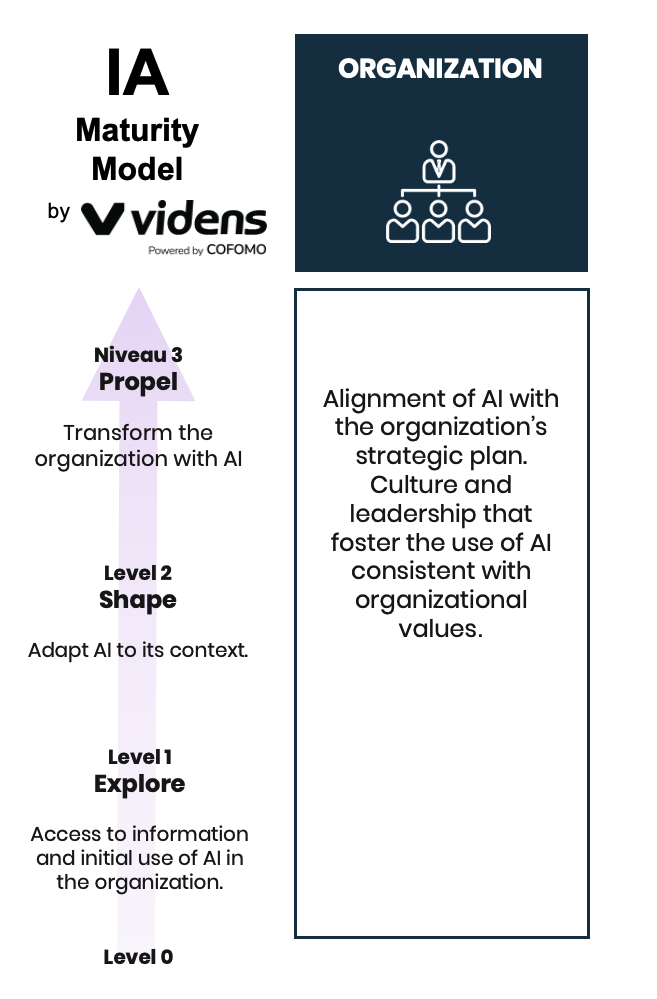
At the first level of maturity, the organization is not well structured in terms of AI governance. Only roles required by regulatory frameworks are assigned, and there is no formal structure to coordinate initiatives.
AI projects emerge sporadically, often driven by a dedicated team or a few more innovative business units. They are not necessarily aligned with the overall strategic plan, and coordination mechanisms with data, security, or risk functions remain limited. This is an exploratory phase where AI progresses, but without a solid organizational framework to ensure consistency, which limits its impact and makes scaling more difficult.
At the second level, the organization begins to clarify roles and responsibilities. A person or committee is designated to coordinate the AI ecosystem, and a governance structure gradually takes shape. Connections are progressively established with existing governance functions: IT, data, risk management, talent, and legal. AI becomes increasingly integrated into strategic planning, and leadership starts to extend beyond the AI team.
The organization moves from isolated initiatives to a more structured, coherent, and sustainable transformation.
At the most advanced level of maturity, governance is robust, consistent, and fully aligned with business objectives and organizational values. Roles are clearly defined, understood, and recognized across all stakeholders. All functions exercise leadership: human resources, operations, legal, risk, IT, and business units.
AI-related decisions are guided by strategic priorities and framed by clear policies. Ethical considerations are actively monitored, and a committee can intervene when needed to ensure alignment with the organization’s and society’s values.
At this stage, AI is no longer an add-on: it is embedded in decision-making processes and day-to-day operations.
A mature organization is one that treats AI as a collective initiative, not just a technological one. This requires clear governance, stakeholder coordination, shared leadership, strategic integration, and alignment with values.
Without these elements, AI remains fragmented, difficult to sustain, and vulnerable to operational and ethical risks. With them, it becomes a powerful driver of innovation, performance, and trust.
AI adoption raises very real challenges for organizations: transparency, fairness, confidentiality, and impact on employees and customers. A mature organization does more than comply with regulations—it ensures that its use of AI reflects who it is and what it aims to become.
This alignment between technology, strategy, and values is what enables sustainable, responsible adoption that truly supports the organization’s ambitions.
Throughout this series, we have explored the five key axes of the AI maturity model by Videns, powered by COFOMO:
• Methods and processes
• Technologies
• Information and data
• Talent et expertise
• Organization
An organization’s progress never depends on a single factor. It is the balance between these dimensions that enables the shift from experimentation to real transformation.
Since 2018, the AI maturity model by Videns, powered by COFOMO, has supported hundreds of organizations in structuring their AI initiatives. It provides a proven methodology to clarify priorities and turn efforts into tangible results.
If you haven’t already, assess your organization’s AI maturity with Lucia and identify your priority areas for improvement across the five axes of the Videns model. Results are available in real time, providing a clear snapshot to guide your next steps in artificial intelligence. www.videns.ai/lucia


.jpg)