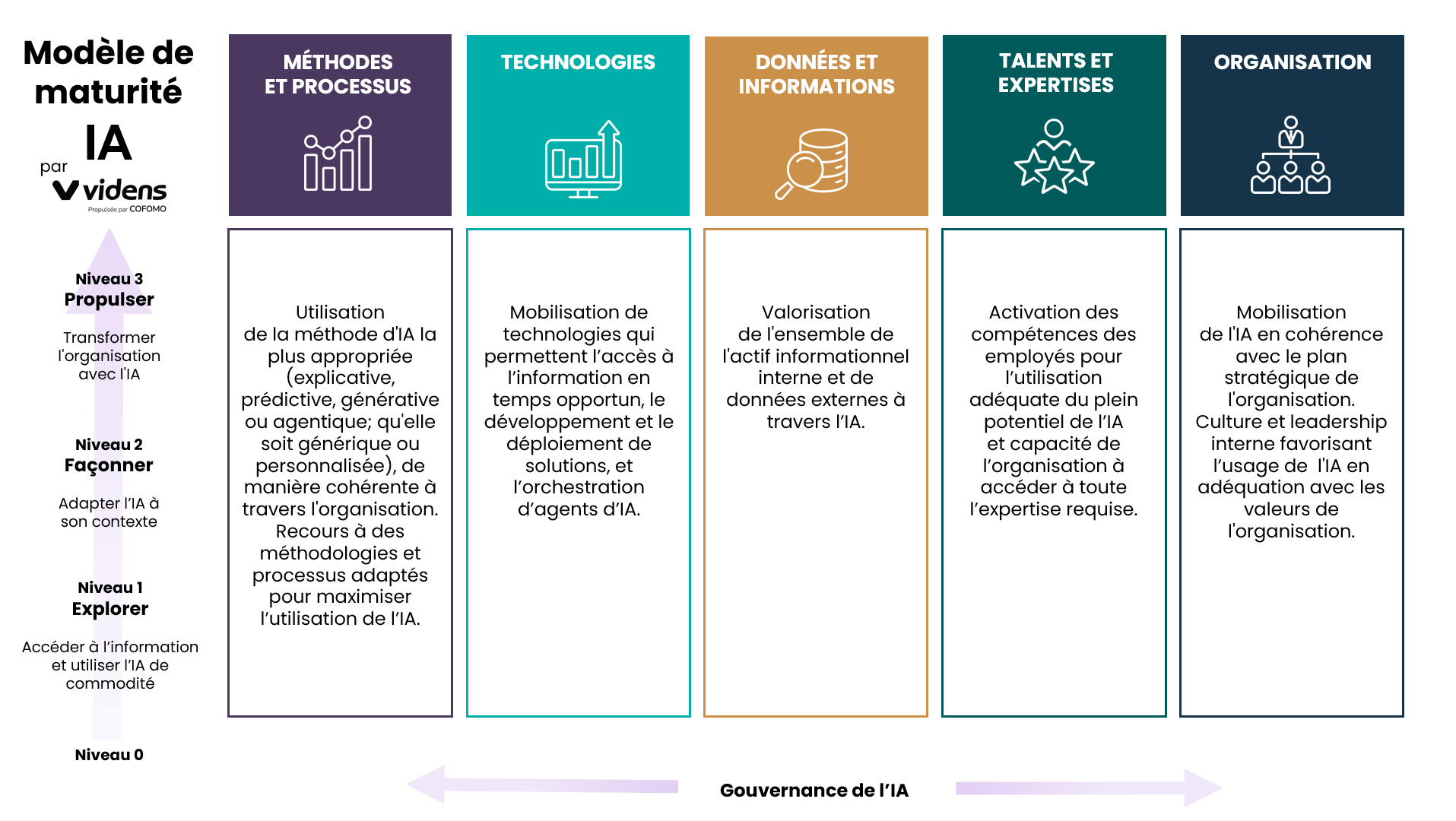
Artificial intelligence may seem spectacular, but its performance relies on a much more fundamental element: information. Without accessible, reliable, and properly governed data, even the best models become useless, or even risky. This is precisely what the Information and Data axis of the Videns AI maturity model assesses.
This axis evaluates an organization’s ability to fully leverage the information it holds: its volume, diversity, accessibility, quality, and governance. It reveals whether data truly supports AI or whether it limits its potential.
In other words, it distinguishes organizations that experiment with AI from those that can personalize it, deploy it, and evolve it at scale.
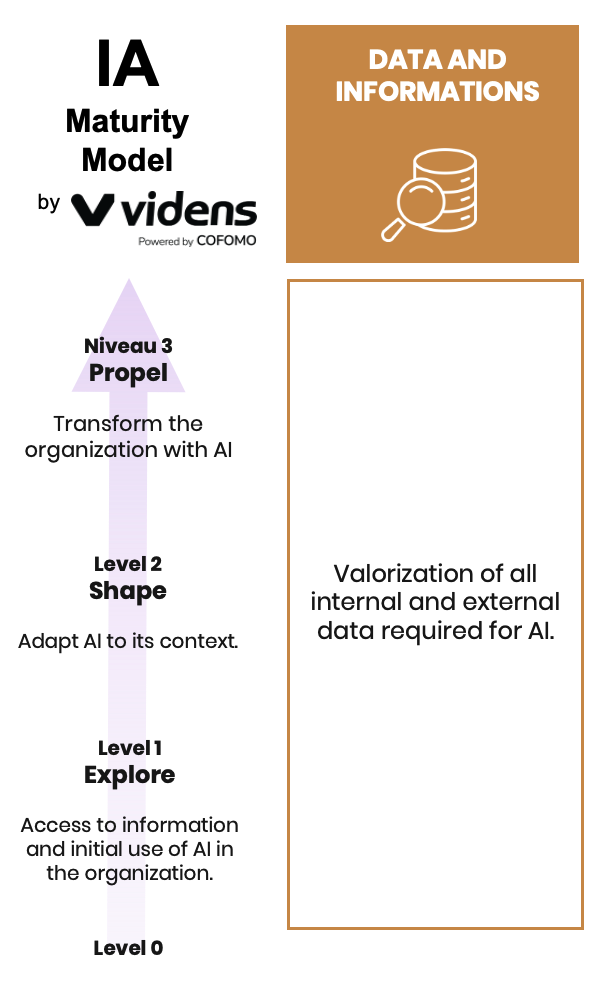
At the first level of maturity, the data required for operations is accessible in a timely manner. The organization generally has access to critical information: financial data, basic customer data, employee information, or essential operational data.
Access management complies with the minimum regulatory framework, particularly with respect to privacy and data lifecycle. However, information often remains fragmented, limited to primary needs, and insufficiently structured to support advanced artificial intelligence use cases.
This is an exploration phase where AI can function on simple use cases, but where personalization remains difficult.
Upon reaching the second level, the organization begins to centralize and enrich its data. The information required to adapt AI becomes accessible in a more structured way, including in various formats: text, images, documents, and unstructured data.
The organization adopts a data strategy aimed at supporting artificial intelligence, notably by improving data quality, gaining better knowledge of data sources, and integrating relevant external data (Statistics Canada, geospatial data, market studies, etc.).
It also implements structured data governance, supported by tools that enable a better understanding and enhancement of the value of its data, notably through data inventories and data dictionaries.
These initiatives make it possible to better understand the available data, ensure its quality, and facilitate its use, thereby promoting its effective mobilization for AI projects. The organization thus moves from available data to data that can be effectively used for AI.
At the most advanced level of maturity, information becomes accessible in real time and interoperable across the organization. Teams can simultaneously use a variety of internal and external sources to power predictive, generative, or agentic models.
Governance goes well beyond minimum compliance: it enables a fluid, secure, and responsible use of data for AI needs. The inventory is exhaustive, and quality mechanisms adapt to the specific requirements of the models.
At this stage, data is no longer just an operational asset: it becomes a strategic driver of innovation, automation, and the creation of new products.
→ Download a copy of the model
One of the main indicators of maturity is the ability to transform data into a concrete lever for artificial intelligence.
At first, the organization mainly uses the data required for its day-to-day operations. Then, it begins to enrich, structure, and diversify its sources. Finally, it actively plans its data collection based on its business objectives and its AI ambitions.
It is this transition from available information to actionable information that enables AI to generate real value.
Without solid governance, AI amplifies existing problems: incomplete data, bias, inconsistencies, and poorly controlled access. Poorly governed data can lead to incorrect decisions, regulatory risks, or a loss of trust.
Conversely, appropriate governance enables:
• compliant and secure usebetter quality results
• more refined model personalization
• deployment at scale
• sustainable innovation
The Information and Data axis is therefore a central pillar of any progress in AI maturity.
How can these levers be structured, developed, and mobilized to support effective and sustainable AI adoption? Discover more in the next article!

Lucia allows you to assess your organization’s AI maturity and identify your priority areas for development across the five axes of the Videns model. Results are available in real time, providing a clear picture to guide your next steps in artificial intelligence.. www.videns.ai/lucia



.jpg)