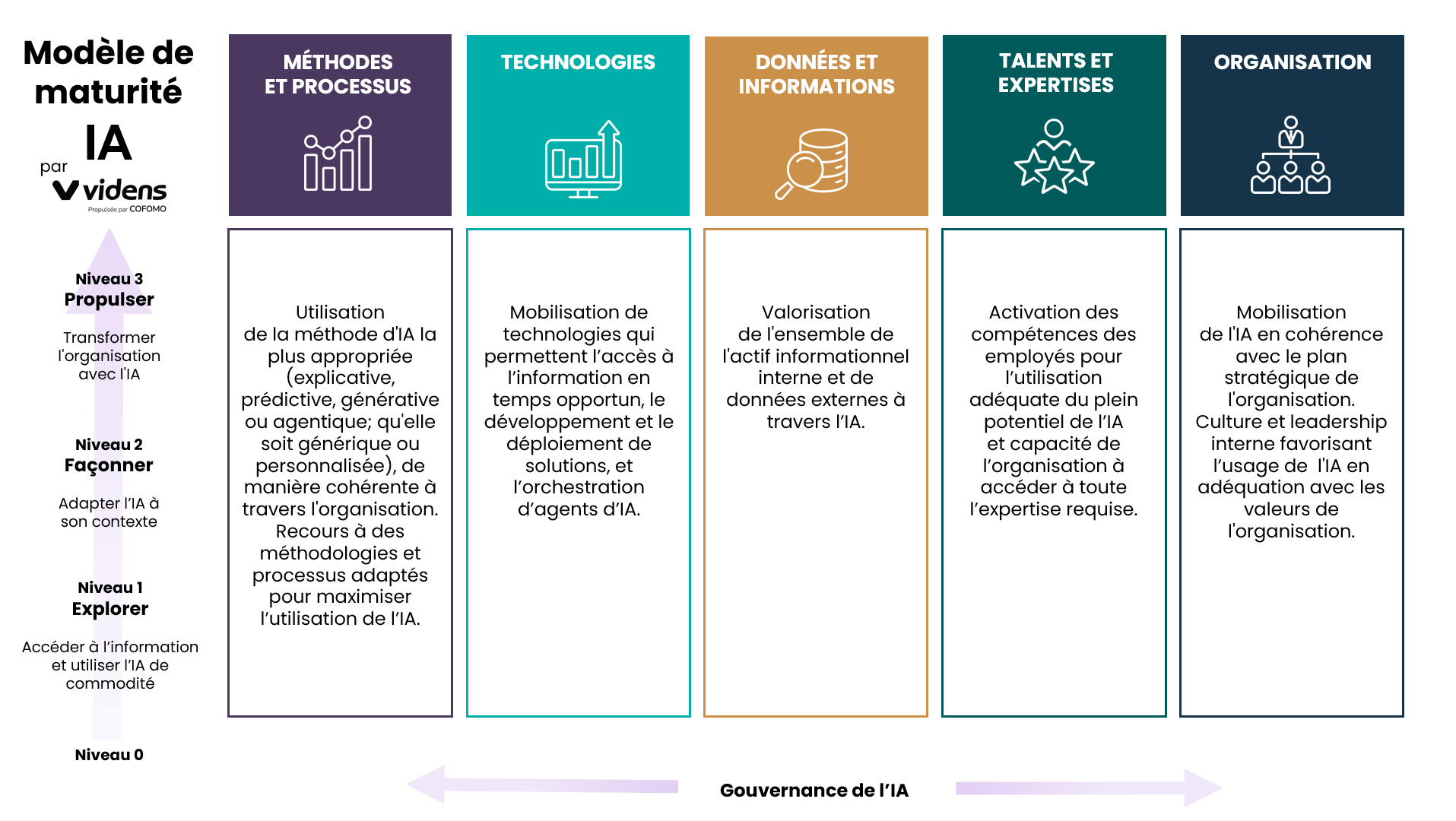
AI does not transform an organization solely through the power of models or the quality of data. It transforms when the right people know how to use it, govern it, question it, and evolve it. This is precisely what the Talents and Expertises axis of Videns’ AI maturity model, powered by COFOMO, measures.
This axis evaluates an organization’s ability to mobilize the necessary skills at all levels: from employees who use AI in their daily work, to decision-makers who set priorities, to experts who develop, integrate, and monitor models—all within the organization’s values and applicable regulatory framework.
In other words, it reveals whether AI is adopted as a technological novelty or as a sustainable organizational capability.
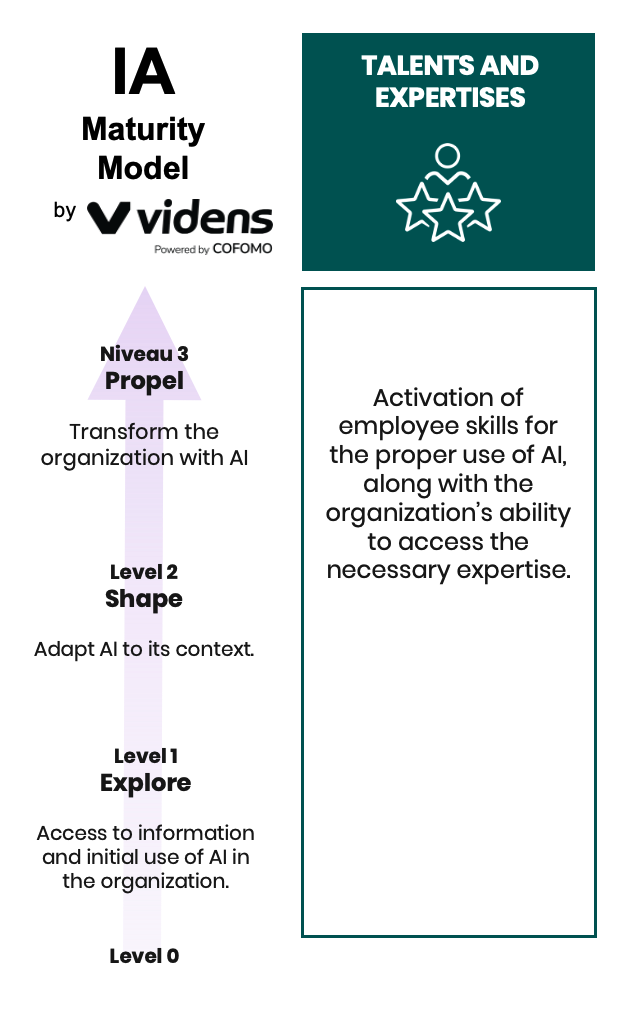
At the first level of maturity, employees have access to commodity AI tools such as Copilot, ChatGPT, or Gemini. They know how to use them cautiously, with some awareness of risks, confidentiality, and ethical considerations.
The organization also has the minimum level of expertise required to oversee these uses and ensure secure deployment. Decision-makers are aware of AI’s potential, but adoption remains limited, often reactive and fragmented.
This is an exploration phase where enthusiasm is present, but risks of error, misinterpretation, or over-reliance on tools are high. At this stage, many organizations believe they are progressing, when in fact they are stagnating.
At the second level, the organization implements a true upskilling strategy. Employees who need it learn how to use AI effectively, craft better prompts, and, most importantly, apply critical thinking to the results.
Decision-makers develop a stronger understanding of different types of AI. They are able to identify opportunities within their sector and exercise active leadership in deploying solutions.
At the same time, AI experts and complementary experts (architects, project managers, risk specialists, legal professionals, and business experts) begin to build the capabilities required to effectively support AI integration.
The organization moves from accessible AI to collectively mastered AI.
At the highest level, the organization has access—internally or through trusted partners—to highly qualified talent across all required areas: data scientists, AI developers, security experts, project managers, architects, legal professionals, and AI ethics specialists.
Leaders have a sufficient understanding of AI’s potential to seize strategic opportunities and transform their sectors. Employees, in turn, become capable of identifying their own opportunities for improvement and innovation through AI.
Expertise is diverse, well-balanced, and enables smooth project execution, without bottlenecks, as all functions operate at a comparable level.
AI then becomes a deeply embedded organizational capability.
→ Download a copy of the model
One of the most important indicators of this axis is an organization’s ability to evolve its capabilities at all levels:
Without this progression, the organization remains vulnerable: dependent on vendors, exposed to risks, and unable to deploy AI sustainably.
AI maturity is therefore also, and above all, a human maturity.
Upskilling cannot be left to chance. The most advanced organizations invest in continuous training, internal talent development, attracting specialized experts, and supporting business teams. This is what enables the transition from isolated experiments to a coherent, responsible, and value-creating adoption.
Ultimately, AI maturity does not rely solely on tools or infrastructure, but on an organization’s ability to develop and mobilize its talent. The organizations that will succeed are not those that adopt AI the fastest, but those that turn it into a collective and sustainable capability aligned with their business objectives.
The final article in the Videns AI maturity series, powered by COFOMO, will explore the concrete levers to activate in order to structure AI deployment across the organization.

Lucia allows you to assess your organization’s AI maturity and identify your priority areas for development across the five axes of the Videns model. Results are available in real time, providing a clear picture to guide your next steps in artificial intelligence.. www.videns.ai/lucia