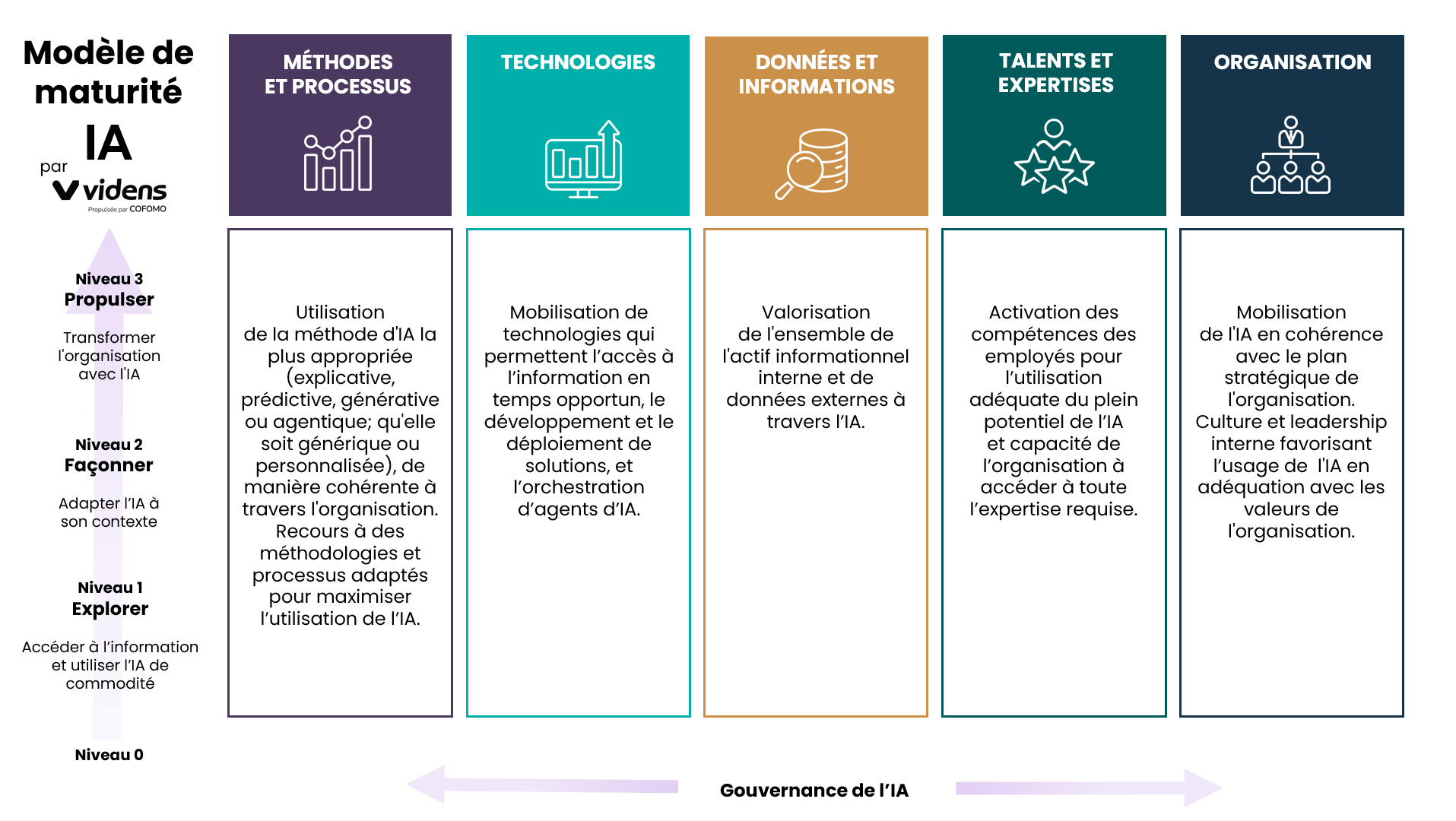
Artificial intelligence cannot be effective without the right technological foundations. Even with strong data and skilled teams, an organization cannot fully leverage AI without a coherent, secure, and interoperable technological base. This is precisely what the Technologies axis of the Videns AI Maturity Model assesses.
This axis evaluates an organization’s ability to establish a technological environment that supports AI at scale: IT governance, tool selection, integration with internal systems, and security adapted to AI-specific risks.
In other words, it reveals whether the organization uses AI as a collection of isolated tools… or as a capability fully embedded within its infrastructure.

At the first level of maturity, the organization has a functional IT infrastructure that meets minimum requirements. It mainly relies on generic tools such as Copilot or ChatGPT, as well as simple analytical solutions. These tools often remain disconnected from internal systems, and security is primarily based on standard controls.
Technology decisions related to AI are made separately, with limited coordination between IT, data, risk, and business teams.
This is an exploration phase where AI can deliver quick wins, but where risks of inconsistency, duplication, and vulnerabilities remain high.
As maturity increases, the organization begins to structure its ecosystem. AI is progressively integrated into IT governance, tools become more diversified, and some solutions are tailored to the organization’s context or developed specifically for its needs.
Interoperability becomes a central priority: connecting AI tools to internal systems, data sources, and operational workflows. Security also evolves, incorporating AI-specific practices such as the protection of sensitive data, vulnerability management, and team training.
The organization moves from accessible AI… to deployable AI.
When the organization operates within a complete, coherent, and optimized technological ecosystem that supports all types of AI — explainable, predictive, generative, and agentic — tools are interconnected, embedded into processes, and capable of operating at scale. The organization then reaches an advanced and fully operational level of technological maturity.
IT governance is fully aligned with the AI strategy. Security becomes proactive, with continuous monitoring, automated incident response, and anticipation of emerging risks.
Infrastructure no longer constrains AI; it accelerates it.
→ Download a copy of the model
One of the most common pitfalls is multiplying tools: one platform here, one chatbot there, another pilot project elsewhere. Without a coherent architecture, these initiatives remain fragmented.
Technological maturity instead relies on the ability to:
• integrate AI into existing systems
• ensure interoperability across tools
• secure usage based on risk levels
• support the full lifecycle of AI models
• deploy at scale without losing control
This transition is what enables AI to become a sustainable performance driver.
The Technologies axis directly supports all other axes of the model. Without a solid infrastructure, it becomes difficult to:
• deploy models reliably
• integrate AI into processes
• protect data and systems
• evolve AI in a responsible manner
An organization may have strong ideas and motivated talent, but without adequate technological foundations, AI will remain confined to experimentation. It is the alignment between a strong technological backbone and the other maturity axes that ultimately drives the success of AI initiatives.
In the next article of the series, we will explore how data access, quality, governance, and availability determine an organization’s real ability to personalize and scale AI.

Lucia allows you to assess your organization’s AI maturity and identify priority areas for evolution across the five axes of the Videns model. Results are available in real time, providing a clear and actionable snapshot to guide your next steps in artificial intelligence. www.videns.ai/lucia