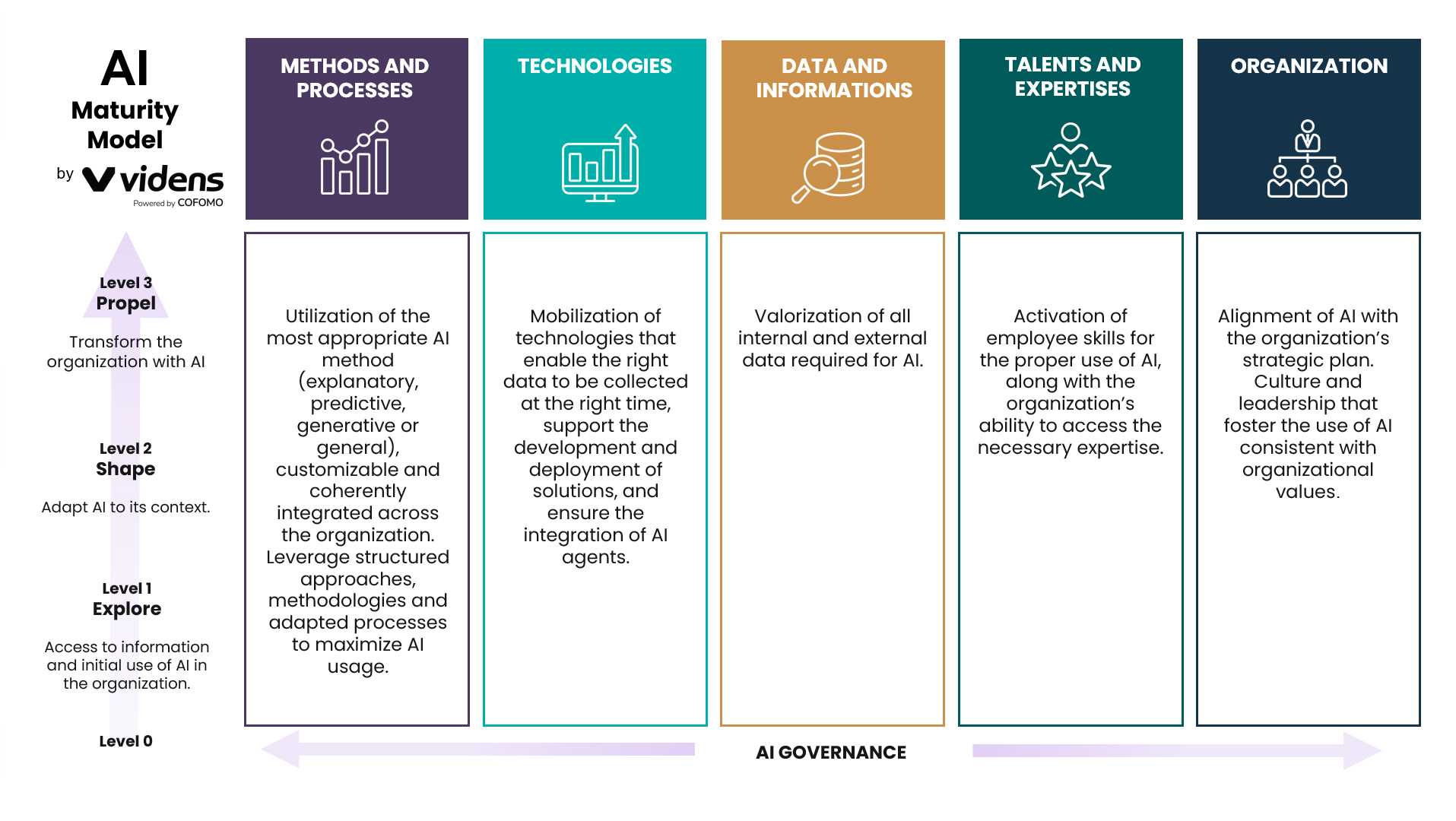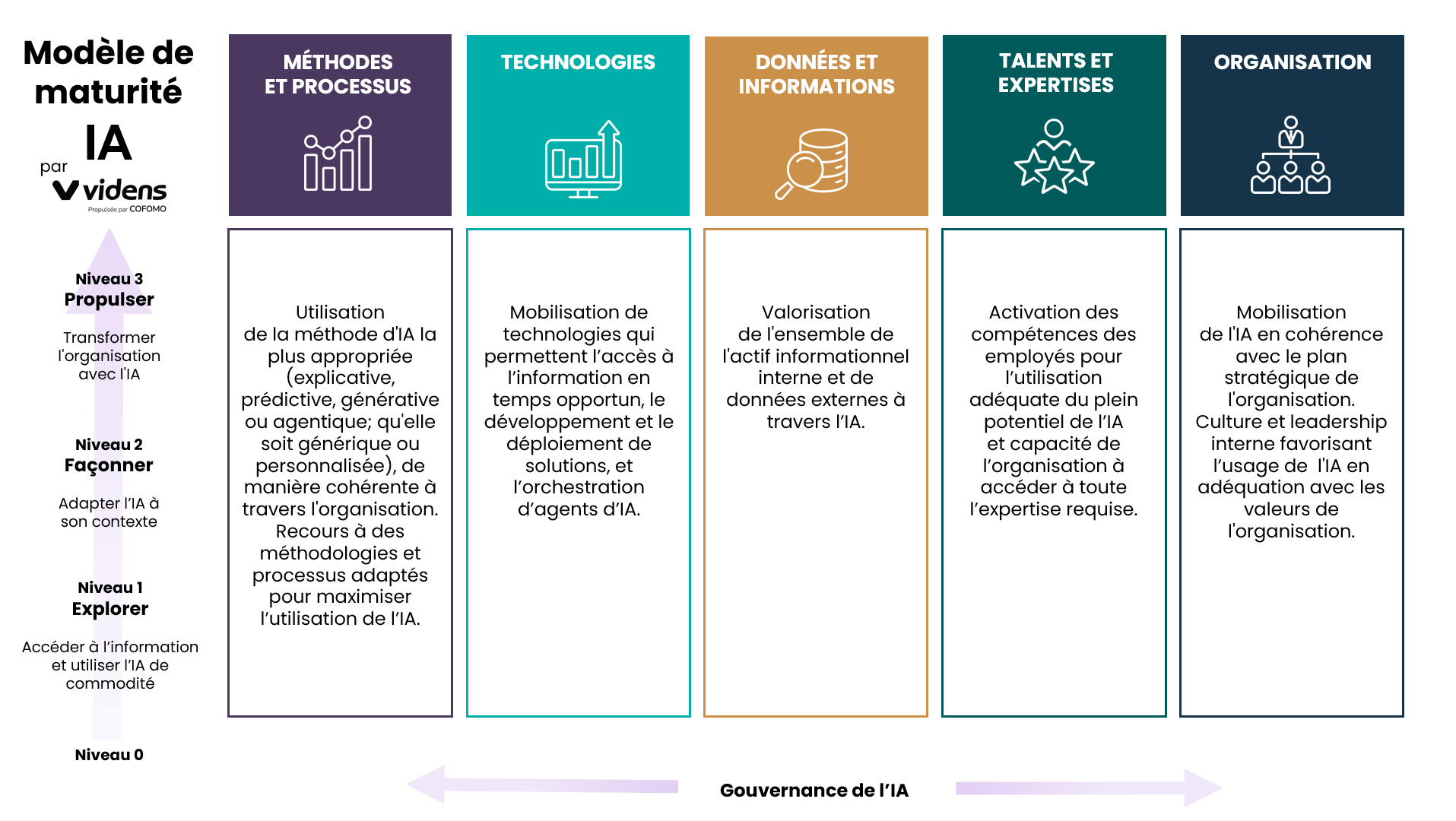
The effective adoption of artificial intelligence does not depend solely on data, technologies, or talent. It also, and above all, depends on an organization’s ability to choose the right approaches, adapt them to its needs, and integrate them rigorously and in a structured manner into its ways of working. This is what the Methods and Processes axis of the Videns AI Maturity Model, powered by COFOMO, is designed to measure.
This axis assesses how an organization uses the different families of AI: explainable, predictive, generative, or agentic and how capable it is of deploying them, monitoring them, and evolving them rigorously within its processes. In other words, it reveals whether AI is applied opportunistically… or integrated as a methodical lever for value creation.
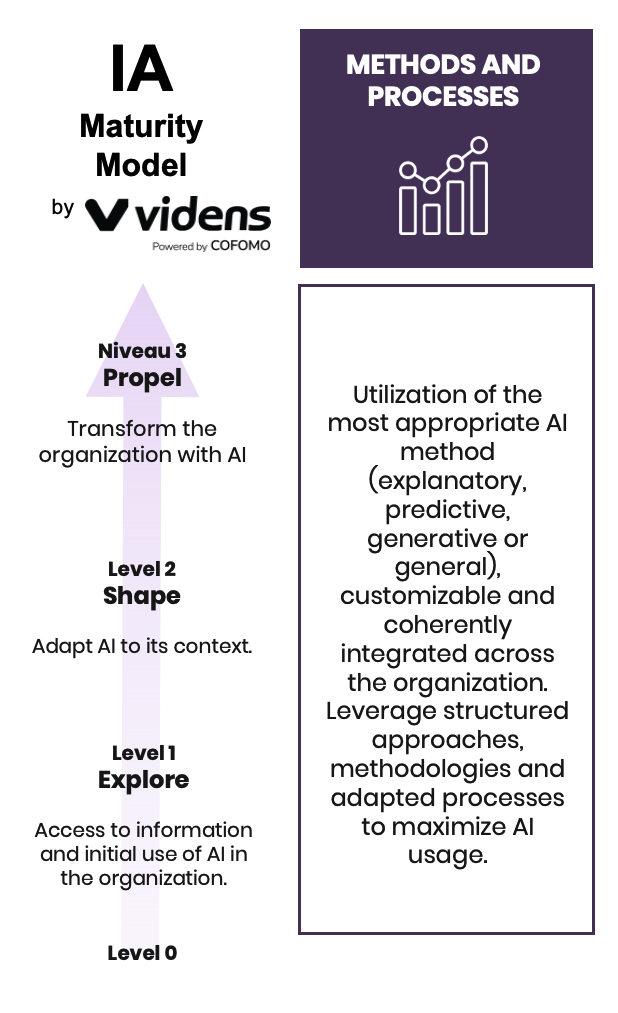
At the first level of maturity, AI is used on a limited and occasional basis. Basic statistics, a few visualizations, and sometimes more advanced methods are present, primarily in specialized areas such as actuarial science or finance. Commodity AI tools, such as Copilot or ChatGPT, may be available, but they are rarely integrated into processes. Deployments are ad hoc, monitoring is sporadic, and the organization does not yet have a unified framework to evaluate or select models. This is an exploration phase in which the risks of drift, error, and misuse are high.
As the organization reaches the second level, it begins to structure its use of AI. It designs its own advanced analytics models, integrates more diverse techniques such as time series analysis or causal inference, and adapts AI to its data and processes. It is also at this stage that practices inspired by MLOps begin to emerge: documentation, testing, versioning, and deployment rules. Business processes evolve, and AI becomes a component that is systematically considered when rethinking a workflow. At this point, the organization moves from “doing AI” to industrializing AI.
At the most advanced level, AI is fully integrated. The organization applies the right method at the right time: explainable AI to understand, predictive AI to anticipate, generative AI to augment, and agentic AI to orchestrate and automate. Processes are sufficiently mature to be partially or fully handled by agentic AI. The MLOps approach is industrialized, with automated pipelines, continuous monitoring, alerts, and rigorous risk management. Integration becomes fluid, coherent, and aligned across the enterprise.
→ Download a copy of the model
One indicator of maturity is how AI integrates into business processes. Initially, its use remains confined to experiments, pilots, or very specific tasks. Gradually, it becomes embedded into operations: automated information extraction, intelligent classification, prioritization, or assisted decision-making.
At the most advanced level, AI is no longer a one-off addition, but an integral part of how the organization operates. Agentic approaches make it possible to automate entire segments of processes, trigger actions, coordinate steps, and reduce operational workload.
AI thus becomes an operational partner rather than an isolated tool.
As highlighted in the previous article, ensuring the harmonious evolution of the five AI maturity axes is essential. The Methods and Processes axis, in particular, ensures coherence between data, technologies, talent, and the organization. Without solid methods and processes, AI remains unstable, difficult to maintain, and unreliable. With well-chosen methods and well-established processes, it becomes performant, secure, and truly aligned with business needs.
This axis therefore plays a priority role in moving from experimentation to a true organizational capability. It enables organizations to reduce risk, accelerate adoption, and ensure that the AI deployed delivers measurable gains.
In the next article in this series, we will explore how the technology ecosystem—infrastructure, integrations, security, and interoperability—influences an organization’s actual ability to adopt and evolve AI.

To position your organization across the five axes of the Videns AI Maturity Model, discover Lucia, an assessment tool designed to diagnose your current position and structure your progression in artificial intelligence. A clear, concrete, and immediately actionable snapshot to guide your next steps. www.videns.ai/lucia