From several days to just a few hours. That is the scale of the improvement observed at a North American insurer we supported, six months after the deployment of its agentic AI solution. Here is what the experience truly taught us.
This third and final article in our series on agentic AI moves beyond theory. We first explored what agentic AI is and why it is a game changer (Article 1), followed by the six foundations to assess before deployment (Article 2). Now, we turn to real-world evidence and a practical method for identifying your first use case.
The organization, a mid-sized North American insurer, processes tens of thousands of claims each month. The process involved five separate teams: intake, document verification, fraud detection, claims calculation and customer communications. End-to-end processing took several business days, while dissatisfaction with the claims channel remained high.
Two previous attempts had failed: a robotic process automation (RPA) project that could not handle exceptions, and a chatbot that could respond but could not take action. The agentic approach was selected for a specific reason: the value did not come from automating a single isolated step. It came from orchestrating the entire workflow while keeping a human in the loop for sensitive decisions.
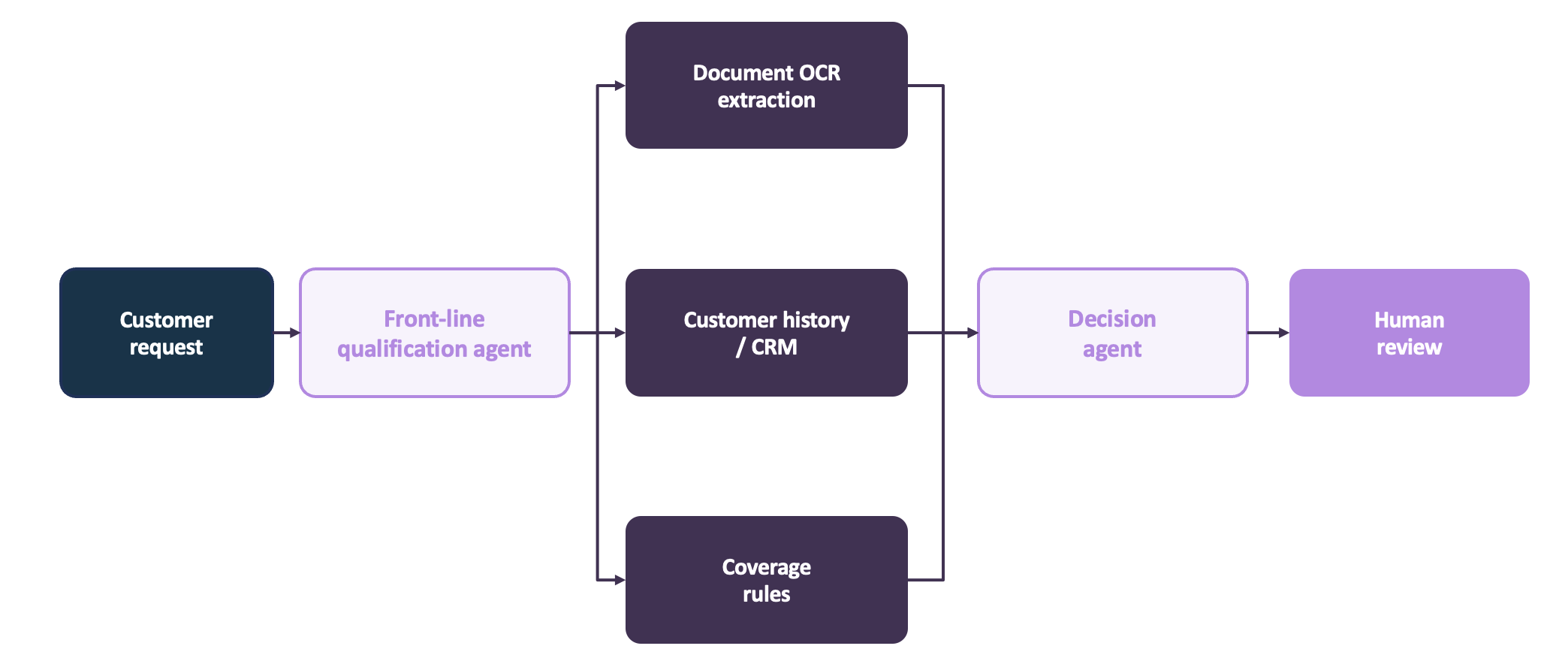
The system was built on a coordinated multi-agent architecture. An orchestrator assigns tasks to specialized agents working in parallel, then consolidates their results. The solution consisted of five components:
Governance was embedded from the outset. Above a defined claims-payment threshold, human approval was systematically required. Below that threshold, the agent could act within a preauthorized scope. Any fraud-related signal triggered an automatic escalation. Finally, 5% of automatically processed cases were reviewed each week by a human evaluator to detect any potential drift.
The results below are based on a real-world deployment. They are presented for illustrative purposes to protect client confidentiality.
Defining the agentic mandate forced us to clarify a process that 20 years of operations had never fully documented. As an unexpected benefit, the AI project became the most effective business-process documentation initiative since the company was founded.
The final performance depended on the quality of the tools made available to the agents, the clarity of the mandate and the rigor of the evaluations. The selected framework and model were useful implementation choices, but they were not decisive.
By refocusing on complex cases and high-value customer interactions, the teams experienced a greater sense of purpose, not just improved efficiency. This shift did not happen on its own: it required transparent communication and a structured change-management approach.
If a use case cannot accommodate human intervention without losing its value, it is not a good candidate for an initial deployment. Agentic AI is not a race toward maximum autonomy; it is a journey in which value must always come before delegation.
Objective - Identify three to five candidate processes and establish criteria for value, risk and feasibility. Assess the six foundations.
Objective - Start with support for research, synthesis and recommendations. Humans still make every decision.
Objective - Introduce tools and APIs, with explicit human approval for sensitive actions.
Objective - Allow execution within clearly defined boundaries for repetitive, measurable tasks, supported by real-time indicators.
Across the use cases we have supported, the break-even point typically falls between 9 and 14 months after production deployment. Indirect returns—such as repositioning teams, improving quality and clarifying processes—often carry as much weight as direct cost savings.
Neither exclusively. The winning approach is to buy the model components, assemble the orchestration layer using a proven framework, and build what creates differentiation: business tools, evaluations and governance.
The question is not, “Which agentic AI solution should we choose?”
It is, “Which process would benefit from orchestration, with which safeguards and along what path?”
Start with that question. The rest will follow naturally.
You are exploring:
Complete a self-assessment to determine your readiness score across the six foundations.
You want to define the scope:
Take part in a 90-minute discovery workshop with our experts to identify your two or three priority use cases.
You are ready to invest:
Conduct a readiness assessment and a structured pilot to move from clarifying the foundations to production deployment.
Agentic maturity does not depend on the model. It depends on the system.
Contact us to discuss your project!