

88 % of AI proof-of-concepts (POCs) never make it to large-scale production. It's not because the models fall short—it's because organizations skip the foundational steps that should come before selecting a model..
Source : IDC / Lenovo, mars 2025 —cio.com/article/3850763
In the first article of this series, we clarified what agentic AI really is and debunked four common misconceptions that often lead organizations to make poor decisions. Today, we're moving from theory to practice: what needs to be in place before deploying your first AI agent?
After dozens of enterprise deployments, one lesson stands out: success depends far less on the model itself than on six organizational and technical foundations. If even one of these is missing, your AI agent won't solve the problem, it will amplify it..
1. Processes
An AI agent can only orchestrate what it is given. If a process is implicit, poorly documented, or full of undocumented exceptions, the agent will produce inconsistent and unpredictable behavior. Before any deployment, map the end-to-end workflow, identify every decision point, and document all known exceptions and edge cases.
2. Data
An AI agent is only as good as the context it receives. Scattered sources, poor-quality data, or poorly managed access lead directly to high-impact errors. Ensure that authoritative data sources are clearly identified, data lineage is documented, and data freshness is measured and monitored.
3. APIs and Tools
An AI agent that cannot take action delivers little value. An AI agent that acts through fragile interfaces creates unnecessary risk. The target systems should expose reliable APIs, support manageable access controls, and, ideally, provide idempotent operations that can be safely retried without causing unintended side effects.
4. Identity and Access
An AI agent should have its own distinct identity, be granted only the permissions it strictly requires in accordance with the principle of least privilege, and operate with comprehensive, auditable logging. Shared accounts and overly broad permissions are incompatible with sound governance.
5. Evaluation
How do you know whether your AI agent is doing what it is supposed to do? Without scenario-based test cases and metrics such as success rates and escalation rates, you are operating blindly. Evaluation is not a project phase, it is an ongoing discipline.
6. Operations
An AI agent in production is a living system. It evolves, it fails, and it will occasionally surprise you. End-to-end observability, active monitoring, incident management, and a continuous improvement loop are not optional—they are essential to ensuring that your deployment remains reliable and sustainable over time.
Note : If the process is poorly defined, the data is unreliable, and access permissions are unclear, an AI agent won't solve the problem—it will amplify it.
For each of the six foundations, three maturity levels define your organization's state of readiness. A serious agentic AI deployment requires reaching at least Level 2 across all six foundations before moving into production.
Whether you choose a single-agent or a multi-agent architecture should depend primarily on the nature of the problem you are trying to solve. A single-agent approach is well suited to simple, linear workflows with limited specialization, where one agent can manage the entire process. By contrast, a multi-agent architecture becomes valuable when the workflow requires multiple areas of expertise, parallel execution of tasks, or clearer separation of responsibilities. In practice, multi-agent systems offer greater modularity, resilience, and scalability, but they also require more sophisticated orchestration.

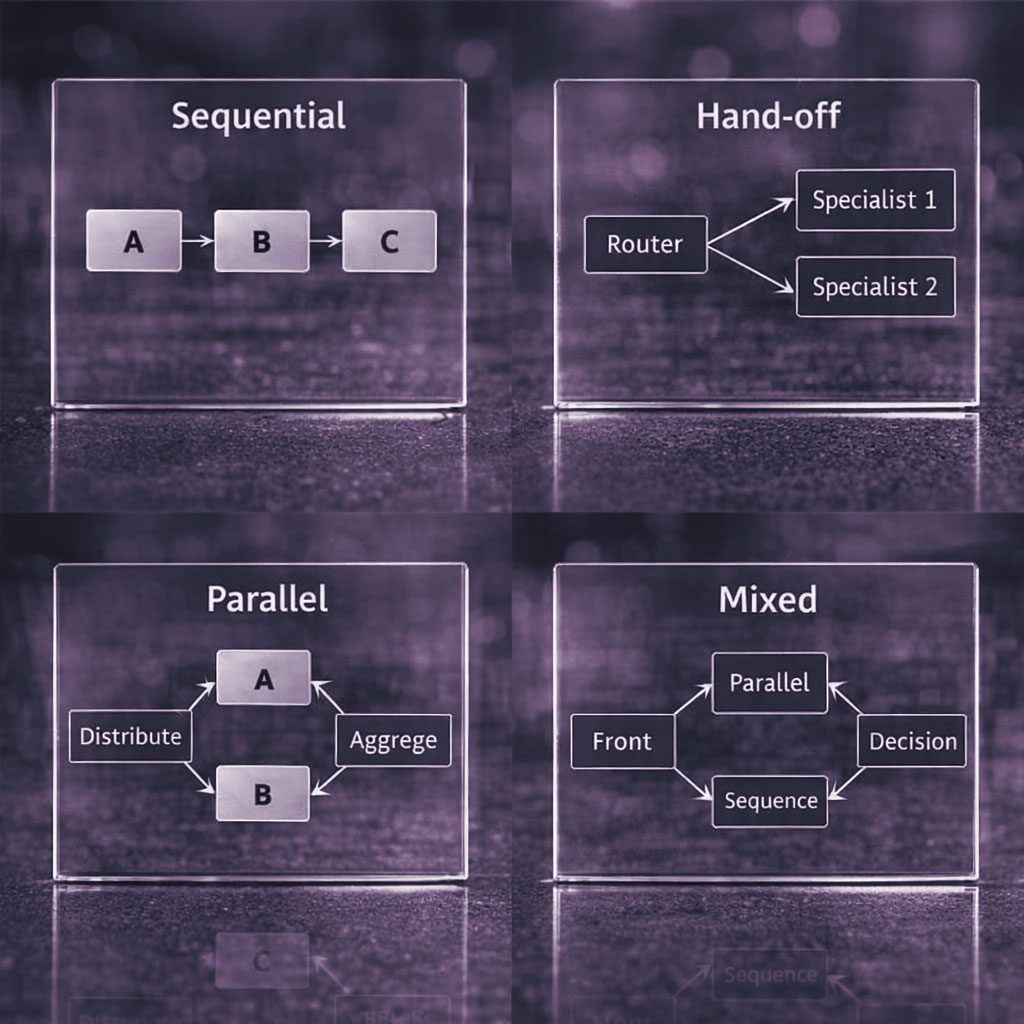
Once the foundations are in place, the choice of orchestration architecture determines how your AI agents collaborate. Four orchestration patterns exist, and in enterprise environments, the most effective solutions typically combine them.
Sequential orchestration: Agents execute in a pipeline, with each step feeding the next. This approach is ideal for linear workflows, such as processing an insurance claim.
Handoff orchestration: A general-purpose agent routes each request to a specialized agent based on its nature. A common example is customer service, where inquiries are directed to billing, technical support, or logistics.
Parallel orchestration: Multiple agents work simultaneously, while an aggregator consolidates their outputs into a single result. This pattern is particularly useful for 360-degree analyses that require querying multiple data sources at the same time.
Hybrid orchestration: A combination of the three previous patterns. This is the most common architecture in production environments because it offers the greatest robustness and flexibility when handling exceptions and complex workflows.
The Three Guardrails to Put in Place from the First Deployment
Organizations that succeed with agentic AI are not the ones that choose the best model. They are the ones that take the time to validate these six foundations before talking about deployment. The agent comes after the system. Never before.
In the next article, I'll walk through a real-world case study, share concrete metrics, and present a practical method for identifying where to start without losing control. Because once your foundations are in place, the next question becomes: Which process should you prioritize first?


.jpg)
